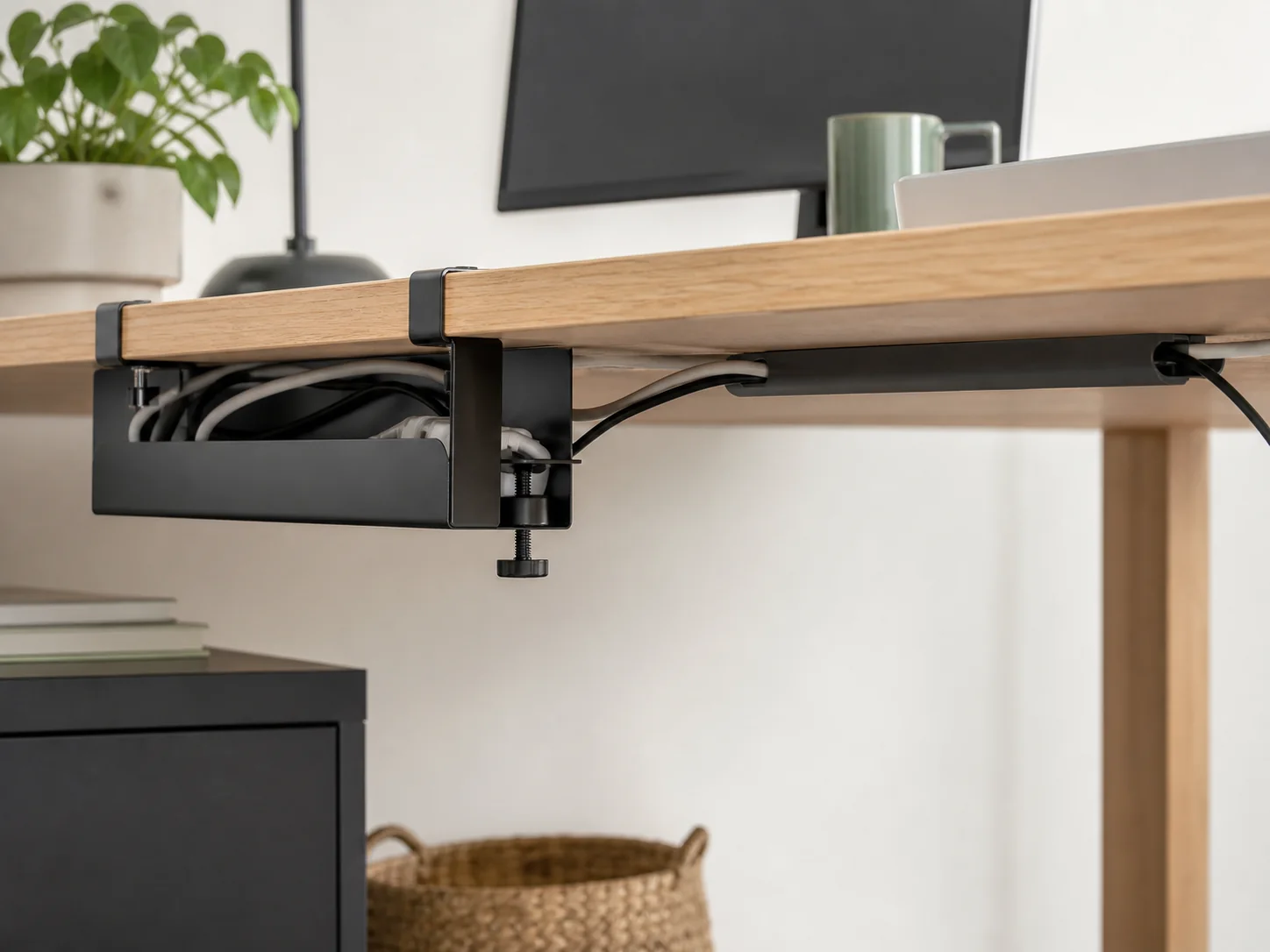
The decision in one minute
Choose a clamp when the desk has a flat exposed edge, the underside is clear, and you want a mount that can be removed without adhesive residue. Choose adhesive when an apron or frame blocks that edge but the underside is smooth, sealed, clean, and suitable for the product’s stated load. If neither condition is true, use lightweight clips or a floor-to-desk sleeve and avoid forcing a tray into the setup.
Side-by-side trade-offs
| Question | Clamp-on | Adhesive |
|---|---|---|
| Needs a free desk edge? | Yes | No |
| Depends on surface chemistry? | Less | Strongly |
| Usually reversible? | More easily | Depends on finish and adhesive |
| Visible hardware? | At the edge | Mostly below |
| Best use | Tray, power strip, adapters | Light tray or channels on suitable surfaces |
When a clamp is the better fit
A clamp converts the desk edge into a mechanical anchor. That makes performance easier to reason about than adhesive: if the opening fits, the contact surfaces are flat, and the desk material can tolerate the pressure, the mount has a defined grip point.
Clamps fail at geometry. A beveled edge can make the pad sit crooked. A deep apron can prevent the lower jaw from reaching the desktop. A drawer or control box may occupy the same space. Also check whether the clamp prevents the desk from sitting flush to a wall.
When adhesive is the better fit
Adhesive mounting avoids the edge and can produce a visually quiet result. It works best when the mounting area is smooth, sealed, degreased according to the product instructions, and left undisturbed for the recommended cure time.
The uncertainty is the desk surface. Dusty powder coat, textured laminate, unfinished wood, fabric, and heat near power adapters can all change performance. “No drill” does not automatically mean “no damage”; removal can lift weak finishes or leave residue.
The practical hybrid
Use the tray only for what needs support. A clamp or suitable adhesive tray can carry the power strip, reusable ties can control slack, small clips can park charging ends, and a sleeve can contain the one run to the outlet. This spreads the job across accessories designed for different loads.
Avoid the capacity trap
A large tray encourages more hardware. Count the actual adapters first, keep the power switch accessible, and leave airflow around warm bricks.
Choose with this order
- Inspect and measure the edge and underside.
- Identify the heaviest item the system must support.
- Decide how important residue-free removal is.
- Check knee, wall, drawer, and standing-desk clearance.
- Compare current manufacturer dimensions and instructions.
If a clamp fits, see the renter cable guide and current examples. If you are unsure, use the two-minute measurement process first.